Lime spreading
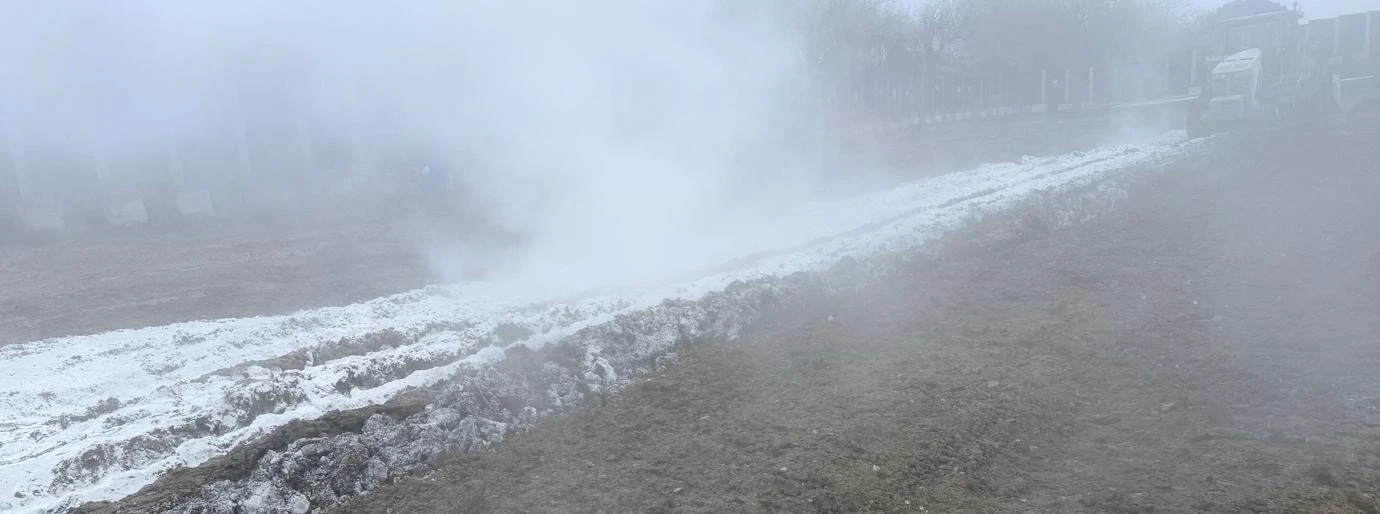
Apply the selected lime product at the rate specified for the soil and treatment depth.
Practical help for construction sites across the UK
Wet ground. Sulphates in your soil report. Uncertainty about treatment. Start with the problem and find out how Furlong GS can help.
Your problem
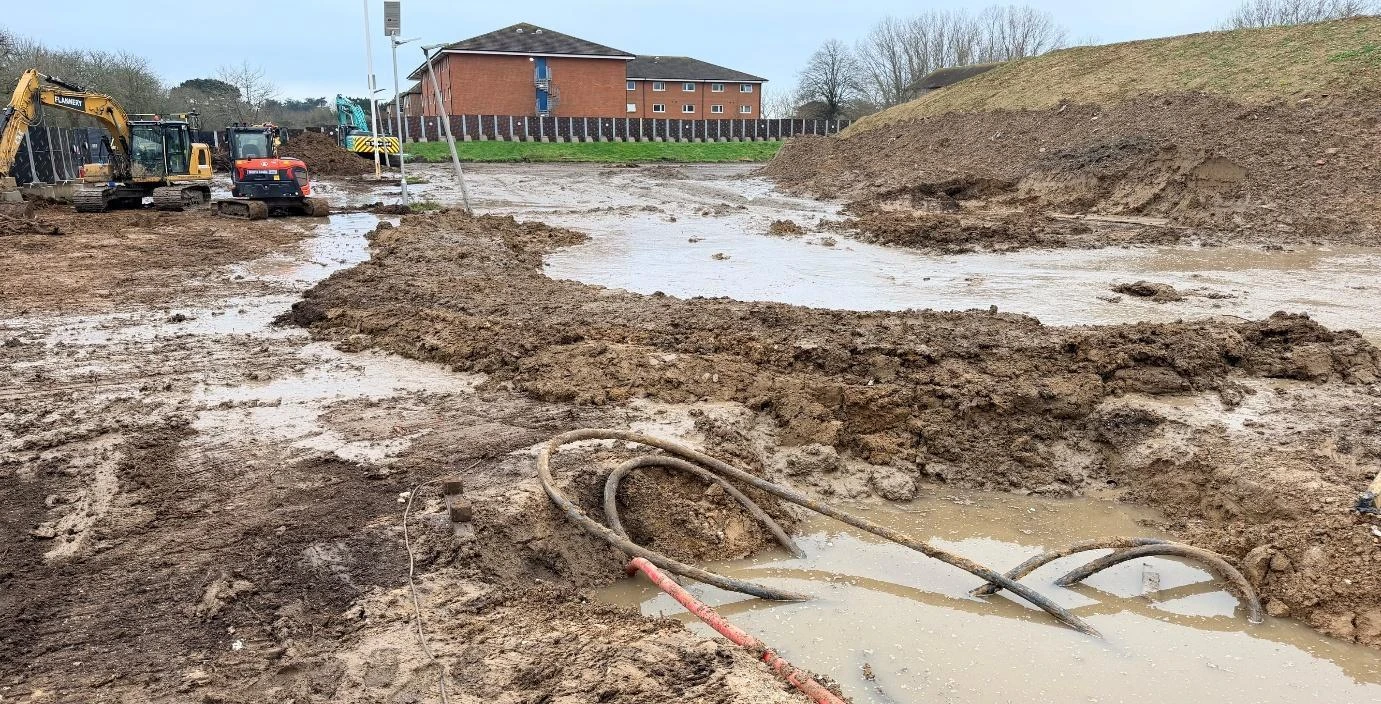
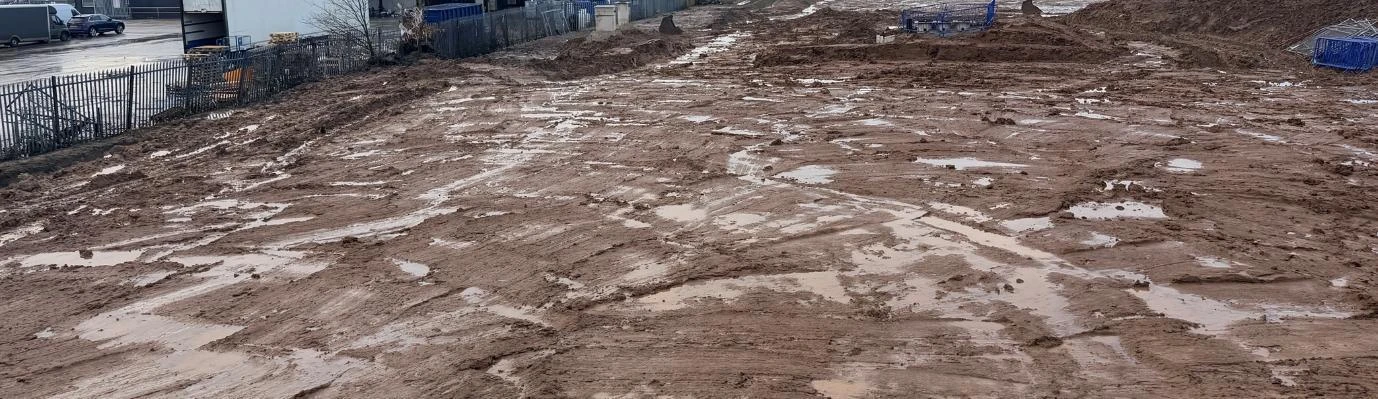
Heavy rainfall can leave your site covered in wet muck and slop. Working conditions deteriorate, the programme slips and costs rise. With more rain possible, simply waiting may not be a practical option.
Scraping up wet material, stockpiling it or carting it away can be expensive and disruptive. Before committing to removal and replacement, find out whether the soil can be treated on site.
The solution
Lime treatment can improve the workability of suitable wet clay and silt soils, helping them to be compacted into a firm working platform. It can provide an alternative to excavating and removing wet material.
Quicklime and hydrated lime are options for wet-soil treatment. The choice of product, treatment rate and method needs to suit the soil, its moisture condition and the intended use of the treated layer.
Start with a site assessment. Where standing water or continuing water ingress is present, water management also needs to be considered; soil treatment should not be assumed to solve every cause of a waterlogged site.
How We Assess and Test Your GroundFrom wet soil to a working platform
Following assessment and selection of an appropriate treatment, work on site involves three main operations.
Apply the selected lime product at the rate specified for the soil and treatment depth.
Mix the lime into the soil to treat the material through the required layer.
Compact the treated material to form the working layer required for the project.
Where treatment is suitable, improving the soil in place can reduce the need to scrape up, stockpile or remove wet material.
A firmer working layer can help contractors progress site preparation and construction activities. The achievable programme depends on the conditions and scope of treatment.
Treatment can also take place after initial grading: mixing lime into suitable soil and compacting it to create a working platform before wet conditions disrupt the project.
Explore Ground StabilisationBefore you decide
Furlong GS can assess whether lime drying or another ground treatment is suitable. Send the site location, photographs and any available ground investigation information so the team can understand the conditions.
Not necessarily. Lime treatment can be an alternative to scraping up and removing suitable wet clay and silt soils. Suitability needs to be established for the material on your site.
Lime drying can be a lower-cost alternative to other ways of handling wet ground. A project quotation depends on the area or volume, treatment depth, soil condition, access, mobilisation and testing requirements.
The aim is to improve working conditions and reduce wet-weather delays. Furlong GS will need to review your site and programme before advising on timing.
Applications include construction sites, floor foundation areas and haul roads. Treatment and verification must reflect the intended use and the requirements for the particular layer.
Your problem
Sulphates and sulphides occur in many UK clays, shales, glacial tills and estuarine soils. Their presence can affect the suitability of lime or cement stabilisation and needs to be considered before choosing a treatment.
In the presence of water, sulphates can react with calcium from binders and alumina in clay to form expansive minerals such as ettringite. This can cause swelling, heave and disruption of a treated layer.
A low result near the surface does not necessarily describe the whole site. Weathering, groundwater and local concentrations can produce different conditions at depth or elsewhere in the works.
The solution
Sulphates do not automatically rule out stabilisation. Furlong GS can review the investigation information and develop a testing-led approach to establish whether treatment is suitable.
Start with available site information, geology and the intended use of the layer. Plan representative sampling around the identified risks, including variations across the site and at depth.
Use the chemical results to select candidate binders. Lime combined with ground granulated blast furnace slag (GGBS) may help control sulphate-related swelling; suitability and proportions need to be established for the particular soil.
Test the soil with the proposed binder, rather than relying on a sulphate concentration alone. Assess swelling alongside the strength and performance requirements for the intended application.
AS measures sulphate already present in the soil. It is considered alongside other chemical results when assessing the potential for expansion.
TPS estimates potential sulphate from total sulphur, including sulphur that is not currently present as sulphate. Expressed as % SO4, it is calculated as approximately three times the total sulphur result expressed as % S.
TPS can be conservative because not all forms of sulphur will necessarily become sulphate in site conditions. A large difference between AS and TPS calls for interpretation, and may justify geological advice or further testing.
Explore Our Testing ProcessSoaked CBR swell testing assesses how the proposed mixture behaves when exposed to water. The testing programme and acceptance criteria must reflect the applicable project specification.
The Furlong guidance discusses monitoring over at least 28 days and extending testing to 56 days where delayed sulphide oxidation or continuing swelling warrants it. These are laboratory assessment periods, not promises about the duration of site works.
Reviewing chemical results early helps identify this testing requirement before treatment is scheduled.
Before you decide
Potentially, but the decision must follow assessment and testing. Sulphate and sulphide content, soil variability, binder choice and the intended use all matter. Elevated results require a more cautious, project-specific approach.
Not without checking the material. A mixture that performs well in one soil may behave differently in another. The proposed binder should be assessed with representative samples from your site.
Combining lime with GGBS can improve resistance to sulphate-related expansion in suitable soils. It is an option to investigate through mixture design and testing, not a guarantee that every sulphate-bearing soil can be treated.
Send the site investigation report, laboratory chemistry results including AS and TPS where available, sample locations and depths, intended layer use, drawings and programme. Furlong GS can then review what is known and identify further investigation or testing needs.
Tell us what is happening on site
Share your site location, photos, approximate area and programme with Furlong GS. Include any ground investigation, sulphate results or other testing information you already have.